Ready for fiber internet
Your wiring and equipment prepared so the faster plan is not wasted on old cable or a weak router.
Fiber Optic
Fiber is the fastest, cleanest way to move data. We help with fiber internet readiness, install fiber between buildings and rooms where Ethernet cannot go, and make sure your home network can actually use the speed you pay for.
What you get
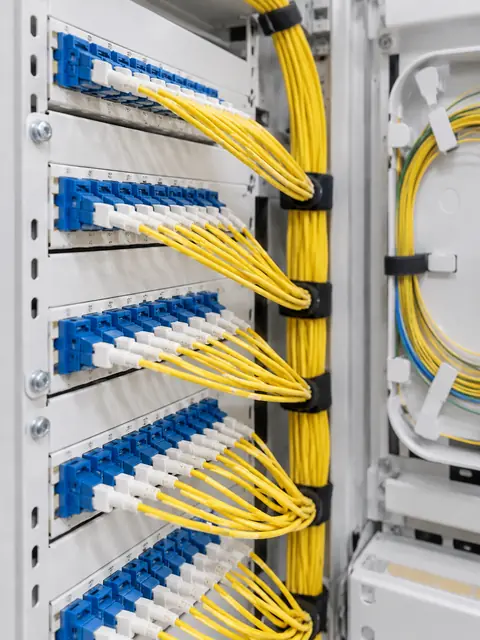
Your wiring and equipment prepared so the faster plan is not wasted on old cable or a weak router.
Link a garage, workshop or backyard office with a fiber cable that is not affected by electrical issues.
Fiber carries data much farther than copper Ethernet, which is limited to about 100 meters.
Glass does not conduct electricity, so it is not affected by electrical noise or lightning surges the way copper can be.
The same cable can carry faster speeds later by swapping the equipment at each end.
Cleaned, spliced and tested connections, with results documented.
What most people don’t know
Plain answers from the install side, so you can decide with the full picture.
Fiber to the home means a glass cable from the provider reaches a small box (an ONT) in your home. From there, the signal is usually copper Ethernet and WiFi. A gigabit fiber plan on old Cat5, an old router or weak WiFi will not feel like gigabit. The last 100 feet decides what you get.
Cable internet is usually much faster to download than upload. Fiber plans are often symmetrical, meaning upload is as fast as download. That matters for video calls, cloud backup, working from home and sending large files.
For most homes, Cat6 or Cat6A copper is plenty, even for 10 Gigabit over typical distances. Fiber makes sense for long runs, between separate buildings, for lightning and grounding isolation, or for a dedicated link to a server rack or media room.
Single-mode fiber has a very thin core for long distances and is the common choice for new installs. Multimode is thicker and is used for shorter runs. They are not interchangeable, and the gear at each end must match. We choose and test the right type for the job.
Fiber needs gentle bends and clean connectors. A speck of dust or a sharp bend can ruin a link. Professional cleaning, splicing and testing equipment is what makes it work for years.
How it works
We look at the space, talk through how you use it and what you want to fix.
A written plan and clear price. Changes are agreed before work happens.
Neat, labeled work, with respect for your home or business.
We test everything, walk you through it and stay available after.
FAQ
Most of the time, no. Good Ethernet cable is enough. Fiber is for long distances, separate buildings, and special cases. We tell you honestly if copper will do.
Availability depends on your building and provider. We can help you check and advise on the best way to connect the building to the service once it is available.
Only if the inside of your network can keep up. A fiber plan combined with wired access points and a good router makes a visible difference.
Fiber cables are thin and flexible and can often follow paths where larger cables cannot. We plan the route before starting and protect the cable.
Fiber cable itself is inexpensive. The cost is in the connectors, the equipment at each end and the specialized labor. We quote the full scope up front.
A short description is enough. We will reply with next steps and a written quote.